
Around writing
- Artist’s Book :
- think about watering the flowers, Edith Azam (Poetry) – Florence Dussuyer (visual), 2023
- Five Uncrowded Shadows, Martin Laquet (Poetry) – Florence Dussuyer (visual), 2015
- A-Over https://peggyviallat.wixsite.com/editionsaover
- Text : Elle and others : Florence Dussuyer for a reading at the Mine Muséum, Saint Etienne 2019
- Text : When the Seasons Return, Happiness, Ed Starry Goat, 2019
- Text : About her, exhibition catalogue at the Matmut Art Centre -Daniel Havis, Ed Snoeck, 2020
ARTISTIC STATEMENT
At a time of global conflicts, ecological deficiency, generalized anxiety, the ultra-visibility of images, overexposure of the self, mass photography, global difficulties entering our lives, the circulation of images, painting serving photographic images in artworks, artificial intelligence increasingly present, including in creation: what is the place of the human being, particularly in the creation of a work of art? What is the place of “corporeal, physical” materiality and of “emotional sensitivity” in contemporary creation and its reception?
It seems to me that the overexposed and over-invested image, saturated to excess, can cause us to lose the physical and profound density of reality, of nature and of the self, of spatio-temporal reality and of the very notion of existence as a “body”. I wish to defend creation in this “trial of the image” through the materiality of painting and through the body of the artist.
It is a responsibility I carry in my sensitive work at a time when technological advances seek to flatten this human density. I seek to highlight the notion of the body in order to “inhabit” creation, and therefore the female body, presence, desire, and extension, through narrative games referencing the history of painting, ceramics, fashion, etc., and everything that runs through me without hierarchy (since the gaze functions this way in its living dynamic).
When I go to paint, there is this urgency: getting up for it, putting on flexible shoes, condensing the energy of the moment. One enters painting, from childhood, as one enters oneself. Each time, one finds oneself on the threshold, in the pleasure of what is to come. It is from this necessity that my artistic practice arises, and also from what deeply constitutes me as a woman, as a being in the world.
It is my own sensitivity, my own relationship to femininity, that I unfold and question. I wish to pay a strong tribute to all women, to those who have shaped our identity and our gaze, and to those we carry within us. My practice is primarily pictorial and works through series: “Ces instants vulnérables” (2016) is a series of portraits of ancient and deep friendships.
I have also continued for several years certain series: “Les Silencieuses” (2023), “Les Endormies” (since 2014), “Les Eveillées” (since 2019), “Les Histoires de femmes” (since 2020). Gradually, this need for space has grown within me, and the desire to explore monumental practice, with for example a 9 m x 180 cm polyptych (2020) or “Quand viendront les jours indomptables”, 6 m x 2 m, acquired by the Paul-Dini Museum. Dance is a parallel, with the collective creation “Pour le meilleur” (2017–2019) on “women’s work”, and “Danser la peinture” (2020), a personal creation: a way of translating into dance, and with my own body, the way I paint.
Occasionally, I also like to approach this theme of femininity through writing, within specific projects.
Volume enters my practice through works such as screens (2017) or the series “Les Désirs portés” (2020), ceramic or plaster dresses as so many dreamed ways of dressing or inhabiting one’s own body.
Drawing also appears quite frequently in my practice: the series “Les Déroulés de soi” (2020– 2022) and “Les Portraits retournés” (2020) were born from the desire to draw on supports — the former on scrolls brought back from Vietnam, the latter on camel bone brought back from India. “Les Voix” (2020) brings together small revisited portraits of suffragettes. It extends the series “Les Anonymes – Les Abîmées” (2016), portraits of women often prostitutes from the 19th century, a tribute I pay to these women who dared to speak, to those of courage whose memory history must revive.
“Les Images manquantes” (2016), based on old erotic engravings, and “Le Jeu des dames” (chess game in resin, glass and paper, 2016) question this subjective limit of eroticism in the image. Finally, “Ce qui nous colle à la peau” (2016) is a small body of work representing tattooed skin, as one inscribes a world or a narrative on one’s own body. The body, the body before thought.
I want to give presence back to the body of painting, to the body in layers that settles on the canvas as if part of oneself refused to renounce this share of animality, this instinctive presence, in the evidence of giving of oneself. A world takes shape in my plastic work that connects: a landscape, an animal, a plant, and bodies that slip into the motif until they lose themselves within it. Painting shows what it hides. Painting is a game of imagination, rebounds and slippages, revisiting art history, cultural references.
A line runs through the material. I draw from myself, I explore with my hands. I move around the canvas under the sun as one dances. I search for the right gesture, rhythm, chromatic relationships that surprise me. I exhaust, erase, peel off, move, overturn, soak, crumple, heat, repaint; I attempt until distancing myself a little further in order to find what must be. A stripping bare, a presence.
There is this urgency, to get up to, to put on soft shoes, to condense this energy of the moment. One enters the painting as one enters oneself. We meet on the threshold, each time, in the pleasure of what will come. My artistic practice comes from this necessity, and also from what deeply makes me as a woman, as a living being in the world. It is my own sensitivity, my own relationship to femininity that I unfold and question. I want to pay a strong tribute to all the women who have shaped our identity, our gaze and our inner selves.
Cover of Secret Voice of Painter, Florence DUSSUYER, 2022
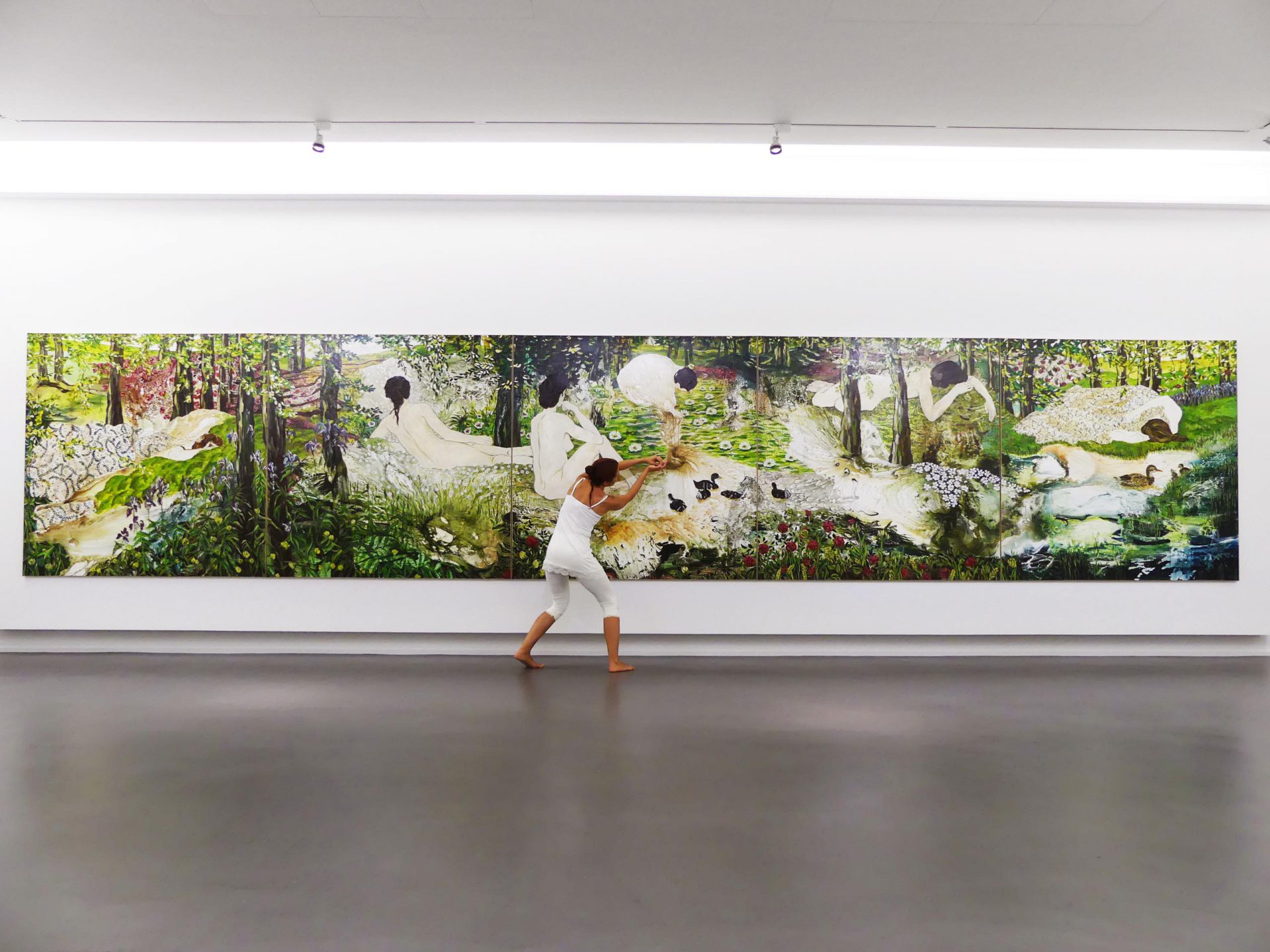
performance and solo show, 2021, Centre d’Art Matmutpourlesarts, (FR)
Around writing
- Artist’s Book : Five Uncrowded Shadows, Martin Laquet (Poetry) – Florence Dussuyer (visual), 2015
- A-Over https://peggyviallat.wixsite.com/editionsaover
- Text : Elle and others : Florence Dussuyer for a reading at the Mine Muséum, Saint Etienne 2019
- Text : When the Seasons Return, Happiness, Ed Starry Goat, 2019
- Text : About her, exhibition catalogue at the Matmut Art Centre -Daniel Havis, Ed Snoeck, 2020